


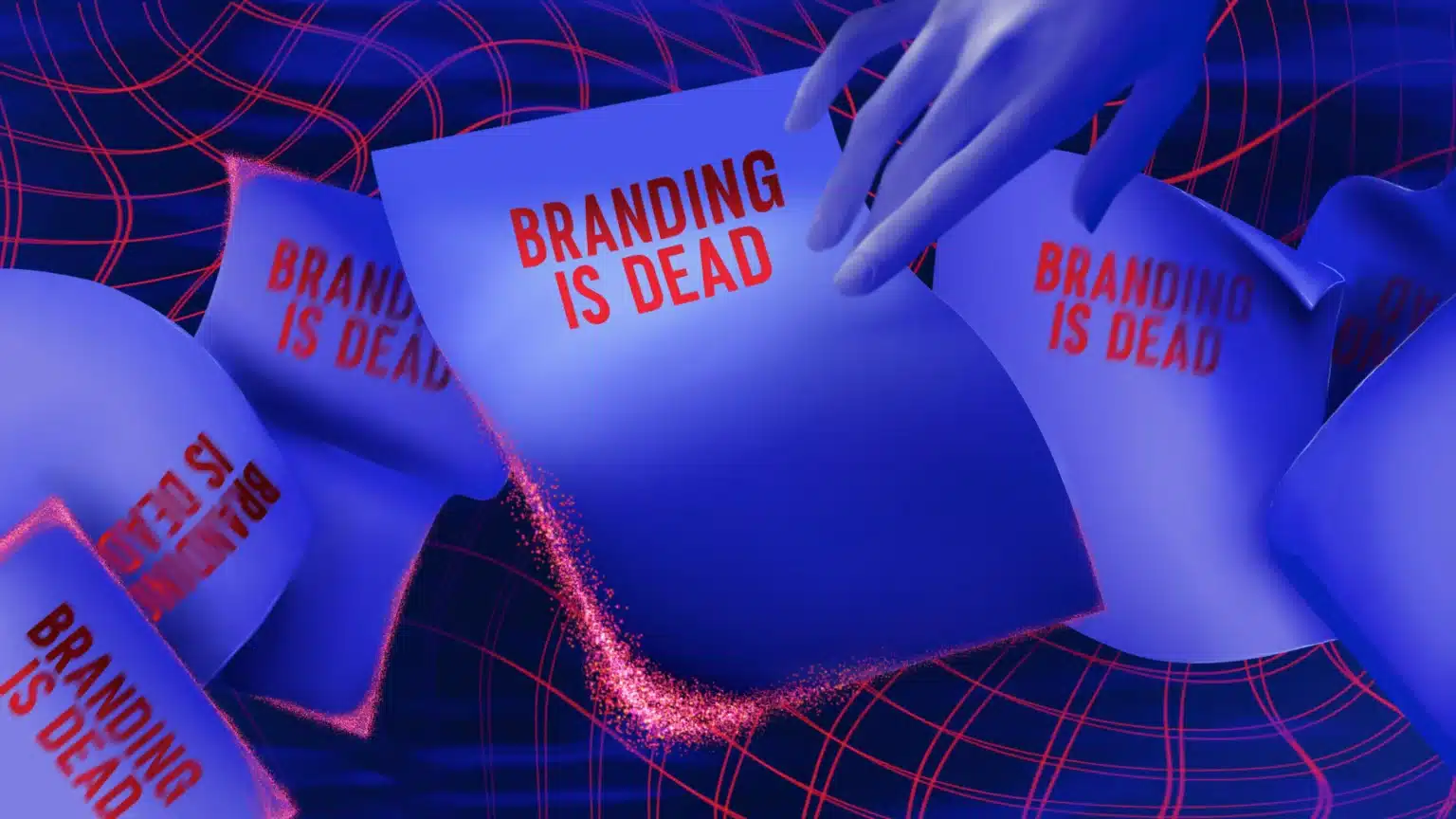
“Branding is dead.”: I came across this thought-provoking message some months ago while doom-scrolling through Instagram. As I lingered on the meaning behind these simple yet disruptive words, I found myself gathering thoughts on the current state of our industry and on what has become increasingly visible when we look around.
Everywhere you look, more than ever, companies have an overall good appearance. Yes, there is still crappy design, but overall, we have improved significantly. A new startup arrives with a clean logo, a careful colour palette, a confident landing page and a founder story polished to the point of inevitability. The boutique hotel opens with cinematic photography, soft lighting, elegant typography and a promise that sounds like escape. The biotech company speaks in gradients and humanist sans-serifs, translating complexity into calm. The real estate development has drone footage, a name that feels vaguely elemental, and a brochure full of sunlight. Even the smallest business can now present itself with the surface confidence of a much larger one.
At first glance, this feels like progress and, in many ways, it is. The world has become better designed. There is less visual chaos, less accidental ugliness, less of that desperate corporate clutter that once filled brochures, websites and trade-show walls. The average company has learned to stand up straight, dress well and speak in complete sentences.
With this in mind, writing the obituary of branding as a discipline may be somewhat premature.
What’s wrong with looking bloody great?
A beautiful website may tell us that a company has taste, budget or access to the right tools. It may tell us that someone has studied the category, collected references, understood the codes and applied them with care. Nevertheless, it does not necessarily tell us that the company knows what it believes in. It says little, if anything, about whether the business has a clear role in the market, a meaningful difference, a point of view, or a reason to be remembered.
Branding has always borrowed from trust. Its promise is simple: if a company looks coherent, perhaps it is coherent.
The visual language of credibility is now widely available. The codes of premium, innovation, wellness, culture, technology, and sustainability are no longer hidden behind specialist knowledge. They circulate freely, endlessly. They are pinned, copied, prompted, templated, adapted, and repeated until they become ambient. A soft gradient borrowed from something seen on Behance. A cinematic crop remembered from somewhere else. A bold statement set in oversized type, because boldness now has a typographic convention. A paragraph about purpose. A photograph of people who look like they are changing the future in a very well-lit room.
The AI explosion has only made this more acute. It does not need to destroy creativity to change the landscape of branding. It simply needs to make the average more available. In a matter of seconds, it can produce the texture of premium, the vocabulary of innovation, the softness of care, the rhythm of purpose, the glow of technology.
This is perhaps the most unsettling part: AI does not need to create bad work to weaken the distinction. It can weaken the distinction precisely by making decent work effortless. When beauty is generated from the memory of everything that already looked beautiful, the result is not necessarily distinction. It is familiarity with better lighting.
Great aesthetics doesn’t mean real value
There is nothing necessarily wrong with looking bloody great.
The work is often good, most of the times, very good. It is tasteful, composed, legible and contemporary. It has the manners of a brand. But after a while, it begins to blur. One homepage dissolves into another. One promise echoes the next. One category teaches everyone to speak in the same temperature of confidence.
This is the new sameness.
For a long time, the work of branding was to help companies escape invisibility. It gave form to ambition and language to difference. It made organizations easier to recognize and, at their best, easier to believe. The logo, the identity system, the tone of voice, the campaign, the website: these were not trivial things. They helped a company become visible to the world and coherent to itself.
But visibility has changed. A company can now look mature before it has become clear. It can perform the rituals of identity without having an identity in the deepest sense of the word. It can have guidelines, assets, templates, motion principles and a perfectly reasonable tone of voice, while still being unable to answer the simplest and most dangerous question:
Why should anyone care?
Looking like a brand is not the same as being one.
Not because identity systems are useless. They are not. Craft still matters. Design still shapes perception. Language still carries weight. A weak visual world can make a strong company look uncertain, just as careless words can make a serious business feel immature. But the surface is no longer enough to carry the truth of a company.
The brand now lives elsewhere too. It lives in all the places the company cannot fully design: in the conversation after the meeting, in the review written late at night, in the sales call that does not follow the script, in the employee post, in the customer complaint, in the search result, in the screenshot, in the investor’s memory, in the way someone explains the company to a friend using words no strategist ever approved. A brand used to feel like something a company owned. Now it feels more like something a company participates in. The company proposes a meaning. The world tests it.
This is why the fantasy of control feels increasingly fragile. The brand book may define the logo space, the colour values, the typography hierarchy and the approved tone. It may be beautifully written and meticulously designed. It may give the company a necessary internal grammar. But the brand itself does not stay inside that document. It escapes the PDF the moment someone has an experience.
- A hotel brand is not its elegant identity if the stay feels careless.
- A healthcare brand is not its reassuring palette if people feel confused or unsafe.
- A technology brand is not its futuristic interface if the product makes users feel stupid.
- A cultural brand is not its manifesto if nobody believes it has earned the right to speak.
Marty Neumeier put it with brutal simplicity: “Your brand isn’t what you say it is. It’s what they say it is.” In other words, the brand does not fully belong to the company that designs it. It belongs, at least in part, to the people who interpret it, test it, repeat it, distort it, ignore it, trust it, or decide not to.
A brand that is no longer yours
People have become fluent readers of inconsistency. They may not use brand language, but they sense when something does not hold. They feel when a company is borrowing emotion it has not earned or when sustainability sounds like a colour-palette decision, or innovation is just a buzzword added to make it look disruptive.
The audience is not passive. It completes the brand, questions it, resists it, remixes it, ignores it or carries it forward. This means that branding, if it is still to matter, cannot remain a cosmetic act (not that, in its deepest sense ever was). It cannot be the beautiful arrangement of signals around an unclear center. It cannot be the outfit a company wears to look more certain than it is.
The future of branding is not making companies look more branded. It is making them harder to confuse.
Harder to confuse not because they shout louder, but because they have a shape. Because their language has a temperature of its own. Because their behaviour confirms their promise. Because they know what they are not. Because there is something in them that resists easy substitution.
That kind of brand is built through decisions, and time. Through the decision to occupy a specific territory instead of floating across all possible ones. Through the decision to disappoint the wrong audience in order to matter more to the right one. Through the decision to speak with tension instead of consensus. Through the decision to let the company’s beliefs influence the product, the service, the experience, the hiring, the partnerships, the markets it enters and the ones it refuses.
Moving up the believability ladder
If looking branded is no longer enough, the task is not to abandon branding, but to make it consequential again. To move it out of the comfortable territory of appearance and back into the harder territory of decisions – moving up in the believability ladder. A brand begins to matter when it stops being treated as the final layer applied to a company and starts becoming one of the ways the company chooses, refuses, behaves and grows.
This is where the work becomes more demanding, but also more insightful. The question is no longer only how the brand should look, sound or feel, but what it should make possible. What should it clarify? What should it protect? What should it make easier to decide? What kind of customer should it attract, and which ones should it gently repel? What should become more obvious after the brand exists than before it did?
A believable brand gives a company a way to make decisions: which opportunities belong and which ones merely flatter. It gives language to the sales team, confidence to leadership, coherence to the product, direction to the experience, and limits to the imagination.
Rooted by these decisions, the brand identity lives as a natural consequence of what the company believes in:
- The tone of voice should be a consequence of how it wants to relate to people.
- The website should be a consequence of how people interact with the business behind the brand.
- The campaign should be a consequence of a tension the brand is willing to own.
- The experience should be a consequence of the promise, not a decorative world built around it.
When branding works like this, it becomes harder to imitate. It is much harder to imitate a company whose brand is entangled with its decisions, behaviours, rituals, standards and refusals.
I am not, in any way, advocating for louder brands. On the contrary. Noise is not meaning, and weirdness without strategy is, once again, cosmetics. The point is not to perform difference, but to become specific enough that difference is unavoidable.
An obituary written for the wrong thing
Perhaps, then, the obituary was not entirely misplaced but simply addressed to the wrong version of branding.
Let the dead thing be branding as an aesthetic performance: branding as the place companies go to look transformed without having to transform. Let us bury the idea that a new identity can resolve old uncertainties.
A brand is something else. A brand is what survives contact with reality, accumulating quietly through repeated proof. It is the expectation people carry before they click, buy, visit, book, invest, recommend or return. It is the memory a company leaves behind when the campaign has ended, the launch post has disappeared down the feed, and the beautifully designed moment is over.
A brand is not what a company says about itself. It is what reality allows people to believe.
So yes, I can agree that “branding is dead”, if by branding we mean another polished identity entering a world already full of polished identities.
But brands are not dead. They are the aftertaste. Probably the only thing that matters.